
I sent a five-question interview around the company last week. One of the questions was "walk me through the last AI tool you tried at work, and what made you keep it or drop it." A teammate answered, on camera, that a tool we'd all been excited about was "fine, it does the job." Clean sentence. If I only had the transcript, I'd have filed it under mild approval and moved on.
Then I watched the signal track for those twelve seconds. Hesitation, sustained. Uncertainty right after. He'd revisited the thought twice before landing on "fine." The word was fine. He was not. That gap is the whole reason I built this thing.
Author: Filip Sardjoski
The tools that read the words
There's a new wave of AI-moderated research tools right now. Listen Labs, Conveo, GetWhy and a handful of others. The pitch is genuinely good: you write a few questions, send a link, and a hundred people answer on camera while you sleep. The platform transcribes everything, clusters the themes, and hands you a report in the morning. I've used a couple of them and come away impressed.
They're all very good at what people said. They're mostly silent on how people said it. The pause before a confident answer. The flicker of frustration the sentence was built to hide. The moment a respondent's face tells you the question itself was the wrong question. That layer never makes it into the report, because it never makes it into the transcript in the first place.
So I built a small reference version of one of these tools with Inter-1 Streaming sitting in the loop, just to see what the report looks like when the behaviour is in it.
What the demo does
The shape is the one you'd expect if you've seen this category:
A researcher signs in, picks a topic, drafts the questions with an AI co-pilot, and shares a public link. A respondent opens that link and records short answers to each question on their webcam. No install, no login. Each answer streams to Inter-1 while it's being recorded, and gets transcribed once it's done. The researcher reads a report per respondent, and an aggregate across the whole cohort.
The part I actually cared about is the seam where Inter-1 slots into that flow.
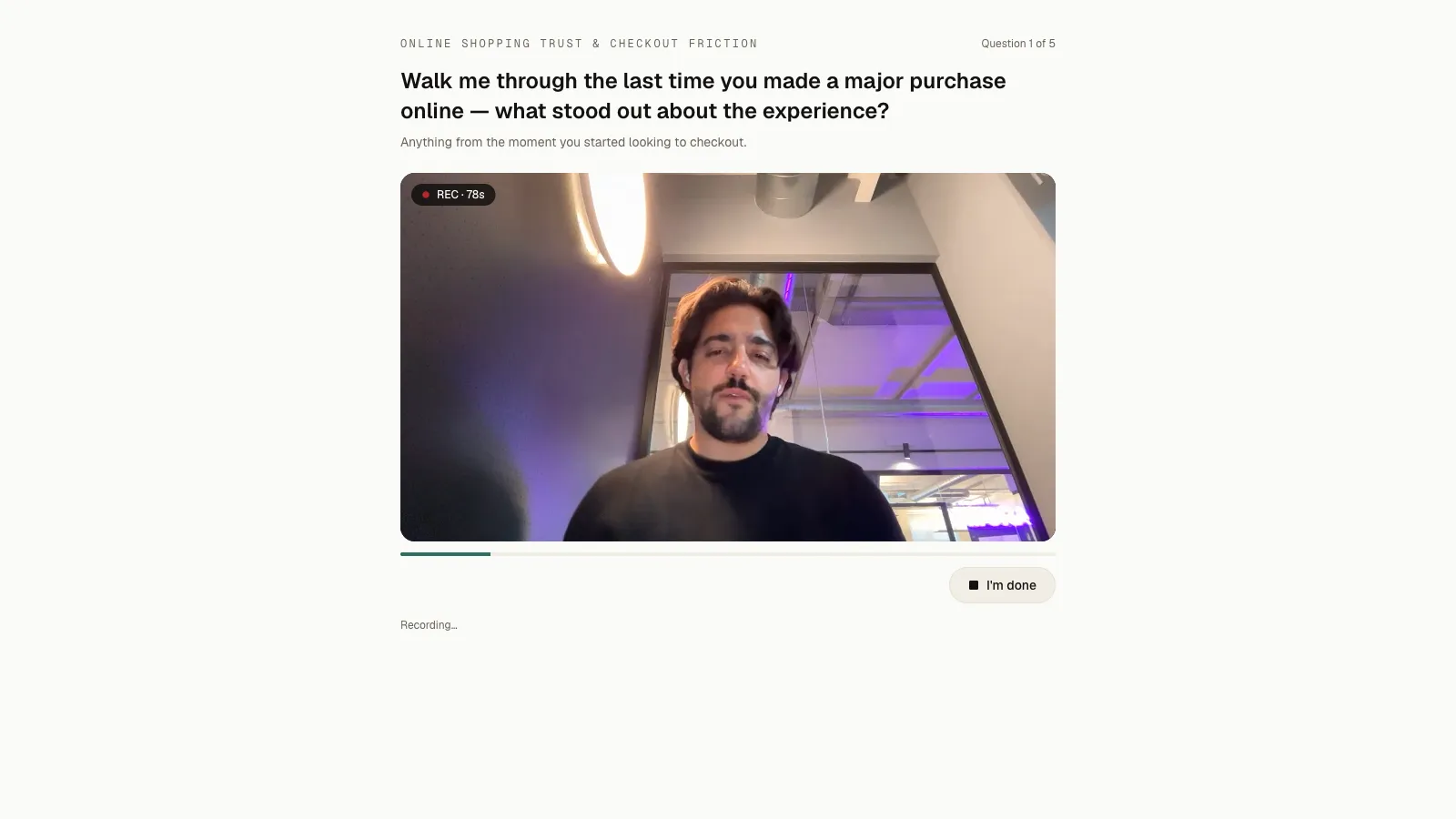
While the respondent talks, each chunk streams to Inter-1 and comes back tagged with the signals it found. Hesitation, confidence, engagement, frustration, agreement, and the rest. The respondent never sees any of this. Their screen is a question, a webcam feed, and a record button, and that's deliberate: the moment you show someone a live confidence meter, they start performing for it instead of answering you. The signals land on the researcher's side. By the time the answer ends they're already pinned to the phrases they belong to, folded into the summary for that answer, and then folded again into the summary across everyone. Nothing waits for an upload to finish.
What changes when the signals are there
In a transcript-only world, every coherent sentence reads about the same. "Yes, the checkout was fine" is "yes, the checkout was fine." There's nowhere else to look.
Put the signals on the same timeline and two things appear that weren't there before.
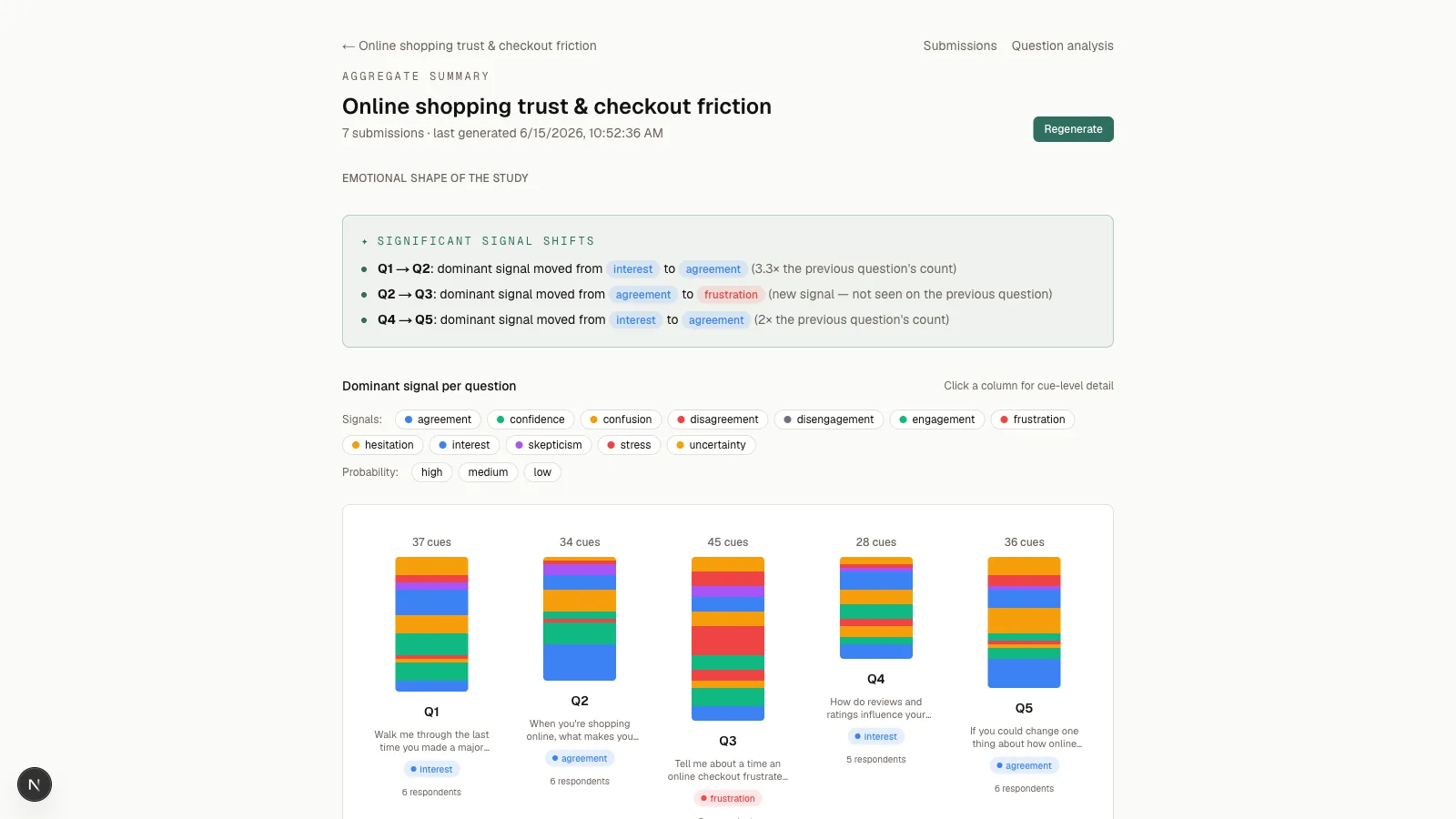
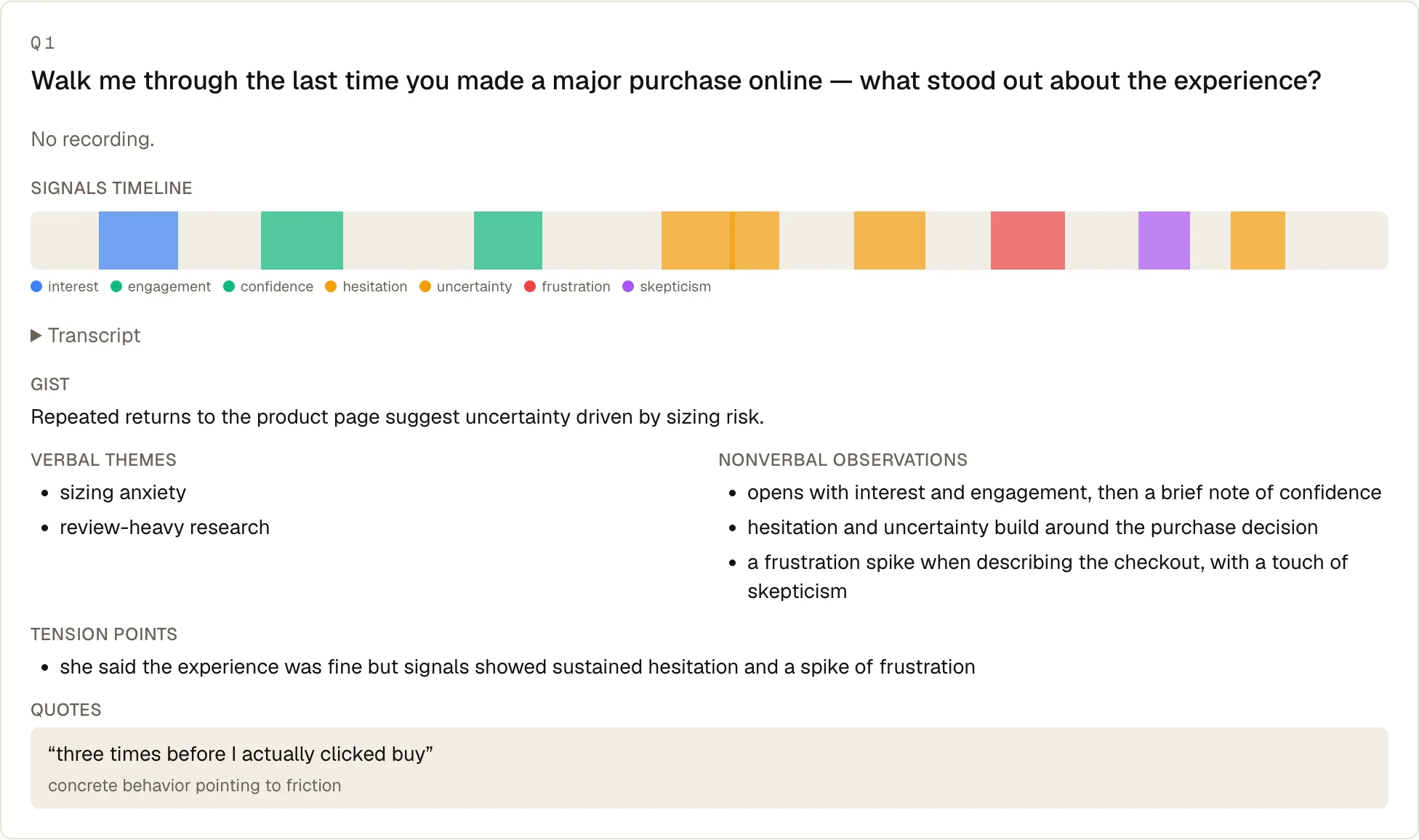
The first is the gap between what got said and how it landed. A respondent says "the experience was fine," and the twelve seconds underneath that answer are sustained hesitation and uncertainty, page revisited three times before they bought. A transcript summariser swallows the polite answer whole. A signal-aware one flags it as a tension point and puts it in front of you. The cohort report has a whole section for findings like that, the ones that only exist if you look at the signals instead of the words.
The second is the pattern you can only see across people. When one question reliably produces a frustration spike across half the cohort, and most of those people still go on to answer "it was fine," that spike is a finding. It's arguably the finding. A transcript-only summary can't see it, because on paper everyone agreed. My teammate's "fine, it does the job" wasn't an outlier. It was the whole room being polite in unison.
None of this replaces the transcript. The transcript is still the spine of the report. The signals are a second track running along the same timeline, and the summary reads both at once.
The seam, for the builders
If you build things, this is your paragraph. The behavioural track is Inter-1 Streaming, and wiring it in is smaller than you'd guess.
The browser records each answer in short chunks and pushes them up as they're captured. The server relays those chunks to Inter-1 over a WebSocket and streams the typed events back down to the client, which drops each signal onto the timeline beside the words:
const events = new EventSource(`/api/stream?sessionId=${id}&token=${token}`);

events.onmessage = (e) => {
  const env = JSON.parse(e.data);
  if (env.type === "signal.detected") {
    const { signal_type, start, probability, rationale } = env.data;
    addSignalToTimeline({ signal_type, start, probability, rationale });
  }
};
Each envelope carries the signal, a probability, a short rationale for why Inter-1 called it, and the window it belongs to. That start timestamp is what lets a badge land on the exact phrase instead of floating somewhere near it. The rest of the demo, the co-pilot, the recorder, the report writer, is ordinary application code. The behavioural layer is the one part I didn't have to invent.
Where I think this lands
The platforms I mentioned up top are doing the genuinely hard work: running interviews at scale, handling the drop-offs, clustering the themes, writing reports a researcher can act on. We are not trying to compete with any of that. The thing I keep noticing is that the behavioural layer underneath all of it, the cues a respondent gives off while they answer, mostly isn't in the inputs the report is built from. It's sitting right there in the video, and it's getting thrown away.
Inter-1 Streaming is meant to be that layer. It runs over a WebSocket, emits typed events as signals start and stop, and is fast enough for the moment-by-moment overlay this demo leans on. A research platform can keep its own ingestion, its own report writer, its own everything, and use Inter-1 for nothing but the behavioural track that turns "what they said" into "what they said, and how it landed."
Three places I think it lands first:
- AI research-interview platforms that want behavioural depth without rebuilding their stack.
- Research teams running interviews in-house who want signal-aware summaries on recordings they already have.
- CX and UX teams running user studies, where the moments worth finding are usually the ones nobody put into words.
We are shipping this. It's a build we're happy to walk you through, fork into something purpose-built, or turn into a pilot.
Talk to us
If you're building in or near this space, at one of the platforms above, on a research team, or somewhere I haven't thought of, and the behavioural layer sounds like it's missing from your reports too, I'd like to hear from you.